



Digital Health Company Founder/CEO & Clinical President Sentenced in $100M Adderall Distribution and Health Care Fraud Scheme
July 07, 2026
|Share Article
|Download Press Release
Health Care Fraud Unit Secures Result in Landmark Case Targeting Executives of Fraudulent Mental Health Technology Company That Distributed over 37 Million Pills of Adderall
NEW YORK – United States Drug Enforcement Administration (“DEA”) Administrator Terrance Cole, DEA Northeast Associate Chief of Operations Frank Tarentino, DEA New York Enforcement Division Special Agent in Charge Farhana Islam, DEA San Francisco Division Special Agent in Charge Bob Beris, along with our law enforcement partners Homeland Security Investigations (“HSI”) New York, U.S. Department of Health and Human Services – Office of Inspector General’s New York Regional Office (HHS-OIG), IRS Criminal Investigation New York, and the U.S. Attorney’s Office for the Northern District of California announced The founder and former Chief Executive Officer (CEO) Ruthia He of Done Global Inc., a California-based digital mental health company, was sentenced today to six years in prison and a fine of $1 million for orchestrating a scheme that used her company’s technology platform, compensation structure, and clinical protocols to unlawfully distribute over 37 million pills of Adderall, defraud insurers of over $12 million, and obstruct the federal investigation that followed. The defendant spent over $40 million on social media advertisements to deceive Americans into believing they had attention deficit hyperactivity disorder (ADHD), falsely diagnosing patients with ADHD, and distributing Adderall, including to patients who the company was warned were suffering from Adderall psychosis, bipolar, depression, anxiety, and other mental health conditions that were worsened by stimulant prescriptions. The goal of the conspiracy was to obtain an over $1 billion valuation by fueling user growth through a subscription for prescription business model whereby patients paid a monthly fee for prescriptions that were automatically refilled and obtained through a frictionless technology platform. Co-defendant David Brody, Done’s former clinical president, was separately sentenced to two years in prison a fine of $1 million.
“Today’s sentencing reflects the serious consequences of abusing the public’s trust and corrupting the nation’s controlled substance system for personal profit,” said DEA Administrator Terrance Cole. “The defendants used the convenience of telemedicine to facilitate the unlawful distribution of highly addictive stimulants, placing communities at risk and undermining legitimate patient care. Whether the scheme operates on a street corner or behind a computer screen, DEA and our partners will continue to pursue and bring to justice those who traffic in prescription drugs for criminal gain.”
“Today’s sentencing of convicted Done Health Founder and CEO Ruthia He and Done’s Chief Medical Officer David Brody for their roles in a $100 million Adderall distribution and health care fraud scheme involving telehealth sends a powerful message to those who seek to exploit technology to facilitate the illegal distribution of controlled substances,” stated DEA Northeast Associate Chief of Operations Frank Tarentino. “The actions of Ruthia He and David Brody, who illegally distributed more than 37 million Adderall pills by weaponizing a digital platform, are no different than those of modern-day drug traffickers, placing profit and greed above the health and safety of the people they exploited. Their calculated misuse of technology to take advantage of patients’ legitimate medical needs has had lasting consequences, fueling addiction and causing immeasurable harm to countless individuals and families. The DEA remains steadfast in identifying, targeting, and holding accountable those who exploit technology and our health care system to profit from addiction.”
“Today’s sentencing of Ruthia He and David Brody demonstrates that no one is above the law when they exploit our health care system and illegally distribute controlled substances for personal gain,” stated DEA New York Enforcement Division Special Agent in Charge Farhana Islam. “By abusing telehealth and circumventing safeguards designed to protect patients, they placed profits ahead of public health and contributed to the diversion of millions of highly addictive Adderall pills into our communities. Whether drug trafficking occurs on a street corner or through a digital platform, the consequences can be equally devastating. The DEA, alongside our law enforcement and prosecutorial partners, will continue to identify, investigate, and hold accountable those who exploit medical professionals, patients, and technology to fuel addiction and endanger lives.”
“DEA targets those businesses that illegally prescribe controlled substances,” stated DEA San Francisco Field Division Special Agent in Charge Bob Beris. “Health care companies that put patents at risk and individuals responsible for taking advantage of the many benefits that telehealth provides will be held accountable. The DEA will bring to justice those who traffic in prescription drugs for profit and remains committed to securing safer and healthier communities.”
Homeland Security Investigations (HSI) New York Acting Special in Charge Pete Gizas stated “Today's sentencing makes clear that DONE Health and its executives will be held accountable for dangerously prioritizing profit over people. They exploited vulnerable patients, concealed critical information from medical providers during rushed appointments, and turned ADHD prescriptions into a $100 million amphetamine pipeline to enrich themselves. Far from providing care, they posed as healers while endangering public safety and undermining trust in the healthcare system. HSI New York and our partners are proud to have helped dismantle this unprecedented fraud scheme and bring those responsible to justice."
“The defendants in this case are guilty of abusing telehealth services to exploit patients for greed,” said Special Agent in Charge Naomi D. Gruchacz of the U.S. Department of Health and Human Services, Office of Inspector General (HHS-OIG). “I want to specifically commend the collaborative law enforcement partnerships that investigated and prosecuted this company’s conduct. Today’s sentencings are impactful and demonstrate that we, along with our partners, will seek to preserve the integrity of the health care system and protect vulnerable populations.”
“When people put profit above the safety and well-being of others, they undermine trust in the systems we all rely on,” said Special Agent in Charge Harry T. Chavis, Jr. of IRS-CI New York. “IRS-CI special agents are specially equipped to trace the complex financial trails left behind by those seeking to enrich themselves at the expense of patient care and public safety. We stand up for victims and remain vigilant, holding individuals accountable for brazen schemes that put lives at risk.”
“Ruthia He hid behind the cloak of medicine to deceive the public, defraud health care programs, and unlawfully deal highly addictive drugs to vulnerable patients,” said Assistant Attorney General Colin M. McDonald of the National Fraud Enforcement Division. “Ruthia He’s business model cast aside medical necessity and patient care in favor of profit and greed. Today’s sentence is a clear warning to every digital health boardroom: if you build fraud or illegal drug distribution into your growth model, the Department of Justice will find you and bring you to justice.”
“Drug traffickers are driven by profits, not people,” said U.S. Attorney Craig Missakian for the Northern District of California. “Whether they operate from a street corner or from a computer, the motive and the resulting harm are the same. These defendants made a choice to operate a telehealth platform that ignored medical necessity and as a result put patients at risk. Today’s sentences send an important message: Telehealth companies prescribing controlled substances must follow medical standards, prioritize patient safety, and comply with the law, and those who do not will be held responsible.”
According to court documents, defendants used a technology platform, management incentives, and clinical protocols that were designed together to corrupt medical decision-making at a national scale. Defendants sought to build a billion-dollar technology company and raise money from investors by advertising easy access to Adderall and other stimulants in exchange for payment of a monthly subscription fee:
Done Health advertisement
Other ads deceived Americans who suffered from other mental health conditions — or simply from inattentiveness due to aging or a lack of structure due to work-from-home policies — into thinking that they were suffering from ADHD, and that Adderall was the solution to their problems.
“When fraudsters steal from Medicare and Medicaid, they’re also stealing from the elderly, disabled, and low-income Americans who depend on these programs and from the taxpayers who fund them,” said Centers for Medicare and Medicaid Services (CMS) Administrator Dr. Mehmet Oz. “But it’s never just about the money. The evidence prosecutors assembled in this case confirms what we’ve seen countless times before: that scammers who are willing to steal your money don’t mind stealing your health or even your life. CMS is proud to work alongside the Justice Department and the White House Task Force to Eliminate Fraud to put criminals like He and Brody behind bars, where they can’t steal from hardworking taxpayers or harm vulnerable Americans anymore.”
Evidence at trial showed that the defendants used a combination of carrots and sticks to cause unnecessary prescriptions. The defendants refused to hire or fired Done clinicians who did not participate in the conspiracy, while paying up to $60,000 per month to clinicians who signed Adderall prescriptions every 30 seconds. The defendants pressured clinicians to diagnose ADHD in initial visits capped at half the length of a typical examination and pressured them to prescribe stimulants to patients who the clinicians did not believe had ADHD or who were at risk for serious side effects. The defendants also used an “auto-refill” platform technology feature after an initial diagnosis to minimize follow-up appointments, where prescribers signed prescriptions for Adderall based on an automatically generated message that a patient desired a refill. Because of these policies, some patients went years without seeing clinicians, who continually authorized refills even through involuntary psychiatric holds or after the patients had died. Brody himself personally wrote prescriptions for 394,324 Schedule II stimulant pills prescribed to 6,559 Done members who were complete strangers to him: he never evaluated them or even reviewed a single patient record. Brody even admitted that “it only [took him] 30 seconds per refill” prescription because he never checked patients’ medical records. As he told defendant He, his dream job at Done would allow him to make money “WITHOUT EVER HAVING TO SEE OR TALK TO THE PATIENT[s].”
“Homeland Security Investigations is committed to protecting American communities from the devastating impact of prescription drug abuse and corporate fraud,” said Acting Executive Associate Director John A. Condon of Homeland Security Investigations (HSI). “These defendants deliberately corrupted medical decision-making and flooded communities with over 40 million pills of Adderall, fueling addiction and worsening the prescription epidemic across the United States. “Their actions put vulnerable patients — including children — at risk. They ignored repeated warnings from clinicians and families, and prioritized profit over safety and health. This case demonstrates the critical role HSI plays in investigating and dismantling complex criminal enterprises that exploit technology and the health care system for profit. HSI remains steadfast in our mission to protect the public and ensure that those who endanger lives for personal gain face the full consequences of their actions.”
The evidence at trial showed that defendants were repeatedly warned by clinical leaders that they would face “legal consequences” for furthering illegal prescriptions, but they nevertheless persisted. He told providers and employees who raised concerns that she would buy an expensive luxury car for the “first person to get arrested.” Defendants also prohibited independent clinical practitioners from discharging patients, and patients continued to receive Adderall even after concerned family members repeatedly notified Done that their children were suffering from bipolar, Adderall-induced psychosis, or other mental health conditions that could be worsened by continued prescriptions. Three mothers testified at trial about their desperate efforts to warn Done that it should not be prescribing to their children, which Done ignored.
Brody encouraged Done’s practitioners to disregard the widely accepted DSM-V criteria. Indeed, Brody described these addictive substances to Done employees as candy that Done providers handed out like Santa Claus. Brody acknowledged that Done’s practices were “on the edge” of the law, remarking that people who were “really into the law” were not his cup of tea. When one prescriber expressed concerns about the legality of Done’s prescribing practices, defendant Brody said that she should prescribe stimulants to patients “no matter what and not worry about going to jail.”
In order to ensure that members continued paying monthly subscription fees, He, Brody, and others conspired to defraud insurers so that Done members would be able to use insurance to pay for Adderall dispensed at pharmacies. He, Brody, and others submitted false and fraudulent prior authorization requests to insurers, which claimed that Done followed the DSM-5 in diagnosing ADHD, utilized urine drug screens, and falsely claimed that non-stimulants had previously been tried without success. As a result, Medicare, Medicaid, and the commercial insurers paid in excess of approximately $12.3 million.
In 2022, faced with scrutiny from the media, He and Brody lied about Done’s policies. When national pharmacy chains began blocking Done prescriptions due to safety concerns, the defendants falsely claimed to have robust compliance measures to ensure the pills kept flowing. Internal documents showed that defendant He ultimately created a secondary entity, Mindful Mental Wellness, specifically to bypass pharmacy blocks and continue dispensing stimulants.
The Health Care Fraud Unit’s investigation reached beyond the individual clinicians writing the prescriptions to examine how corporate decisionmakers controlled its operations. To obstruct the government’s investigation, the evidence at trial showed that He moved operations to China to make personnel and evidence unavailable. After receipt of the grand jury subpoena issued to Done, He instructed Done employees to move to encrypted messaging applications, such as Signal and WhatsApp, to discuss sensitive company business, instead of using official company platforms that were being collected by Done’s attorneys for production to the government. He also turned on “disappearing messages” in her communications with Done colleagues, rendering it impossible to obtain such messages. He also personally deleted and directed employees to delete incriminatory documents and messages from the company servers. As the investigation closed in, He continued to move assets and company operations abroad. She researched non-extradition countries on her MacBook and saved a screenshot of the results:
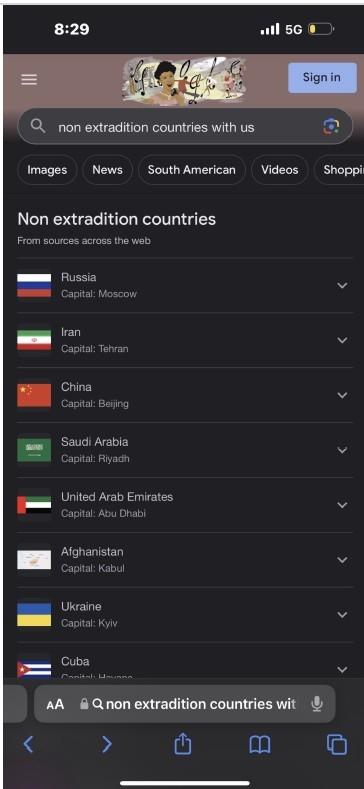
Image of He's search for non-extradition countries.
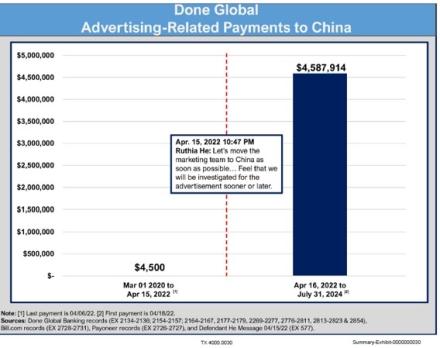
Chart of Done Global Advertising-Related Payments to China.

Notification of He turning on disappearing messages.
In Feb. 2023, agents intercepted He on her way to the airport, bound for a flight to Hong Kong. She surrendered her passport and was warned that leaving the country would result in arrest. Four months later, however, she secretly obtained a Chinese travel document that would allow her to travel to China — a fact she concealed from the court and law enforcement following her arrest and that ultimately led to her pretrial detention due to her risk of flight. He also set up a shell company — MakeBelieve Asia — and transferred millions of dollars to China.
In Nov. 2025, He and Brody were both convicted of one count of conspiracy to distribute controlled substances, four counts of distribution of controlled substances, and one count of conspiracy to commit health care fraud. He was also convicted of one count of conspiracy to obstruct justice.
The DEA New York Enforcement Division’s SPEAR Group 2, DEA San Francisco Field Division, HHS-OIG, HSI, and IRS Criminal Investigation investigated the case.
Acting Health Care Fraud Unit Chief Jacob Foster, Assistant Chief Emily Gurskis, and Trial Attorneys Arun Bodapati and Raymond Beckering III of the Justice Department’s Health Care Fraud Unit and Assistant U.S. Attorney Kristina Green for the Northern District of California prosecuted the case. The sentence is the first sentence announced since the creation of the West Coast Strike Force in the Northern District of California, District of Arizona, and District of Nevada.
On April 7, the Department of Justice announced the creation of the National Fraud Enforcement Division. The core mission of the Fraud Division is to zealously investigate and prosecute those who steal or fraudulently misuse taxpayer dollars. Department of Justice efforts to combat fraud support President Trump’s Task Force to Eliminate Fraud, a whole-of-government effort chaired by Vice President J.D. Vance to eliminate fraud, waste, and abuse within Federal benefit programs.
Since its inception in March 2007, the Fraud Division’s Health Care Strike Force program, currently comprised of nine strike forces operating in federal districts across the country, has charged more than 6,200 defendants who collectively billed federal health care programs and private insurers more than $45 billion. In addition, CMS, working in conjunction with HHS-OIG, are taking steps to hold providers accountable for their involvement in health care fraud schemes. More information can be found at www.justice.gov/criminal-fraud/health-care-fraud-unit.
###